Field notes / Solar & storage
Where does tomorrow’s charge come from?
After a day on the 3600, I started planning for four. Here’s how I’d keep one station working while another recharges.
By Tony Davis · Pacific Northwest
During our 24-hour outage the fridge and office shared my HomePower 3600 Plus. It still had charge when the power came back. The question I took away was what I’d do if the same outage stretched into a second, third, or fourth day.
What I keep ready
At my desk, a HomePower 2000 Plus v2 works as an uninterruptible power supply (UPS) for the computer and monitors. I have a spare 2000 Plus v2 and a spare 1000 Plus v2 that I can move to the job that needs one. The 3600 is my larger reserve. A separate station gives me another set of outlets as well as another battery.
How I’d make a swap
Say the office station is getting low in the morning. I’d save my work, shut down the desktop, and move the equipment I still need to the charged spare. The first station is now free to take whatever charge the panels can provide. Before dinner I’d check what actually came back and decide whether the extra monitors earn another evening of power.
Panels outside, stations inside
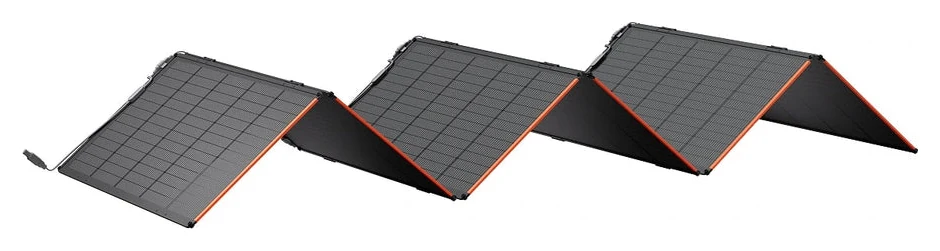
I bought two SolarSaga 500X sets, the connectors to divide the sets into smaller groups, and two 30-foot solar extension cables. The cable length matters in my house. It lets me put the panels where the sun is and keep the stations indoors. The 500X has six detachable sections, so I can plan around more than one station.
I chose the sets with the 3600 Plus, 2000 Plus v2, and 1000 Plus v2 in mind. Jackery offers the 500X with the 3600 and 2000. For my HomePower 1000 Plus v2, I’d confirm the exact panel arrangement with Jackery before connecting it. The similarly named Explorer 1000 Plus is a different station.
For the Explorer 600 v2, I already have the original 100W panel. I’m curious whether one or two sections of the 500X would work on the 600. That pairing is still an open question. The sections connect in parallel, so using fewer sections doesn’t lower their voltage.
Jackery’s equipment references · 500X panel guide · 3600 kit · 2000 Plus v2 · 1000 Plus v2
Try it with what you own
Choose one job you’d still need done tomorrow. For a fridge, measure the energy it uses across an evening so you capture its on-and-off cycles. If you own a panel, record how much energy it puts back on a day when you can try it. Those two numbers tell you more about your second day than the wattage printed on the box. For a day with no useful sun, work from the charge already in the house.
All field notes